
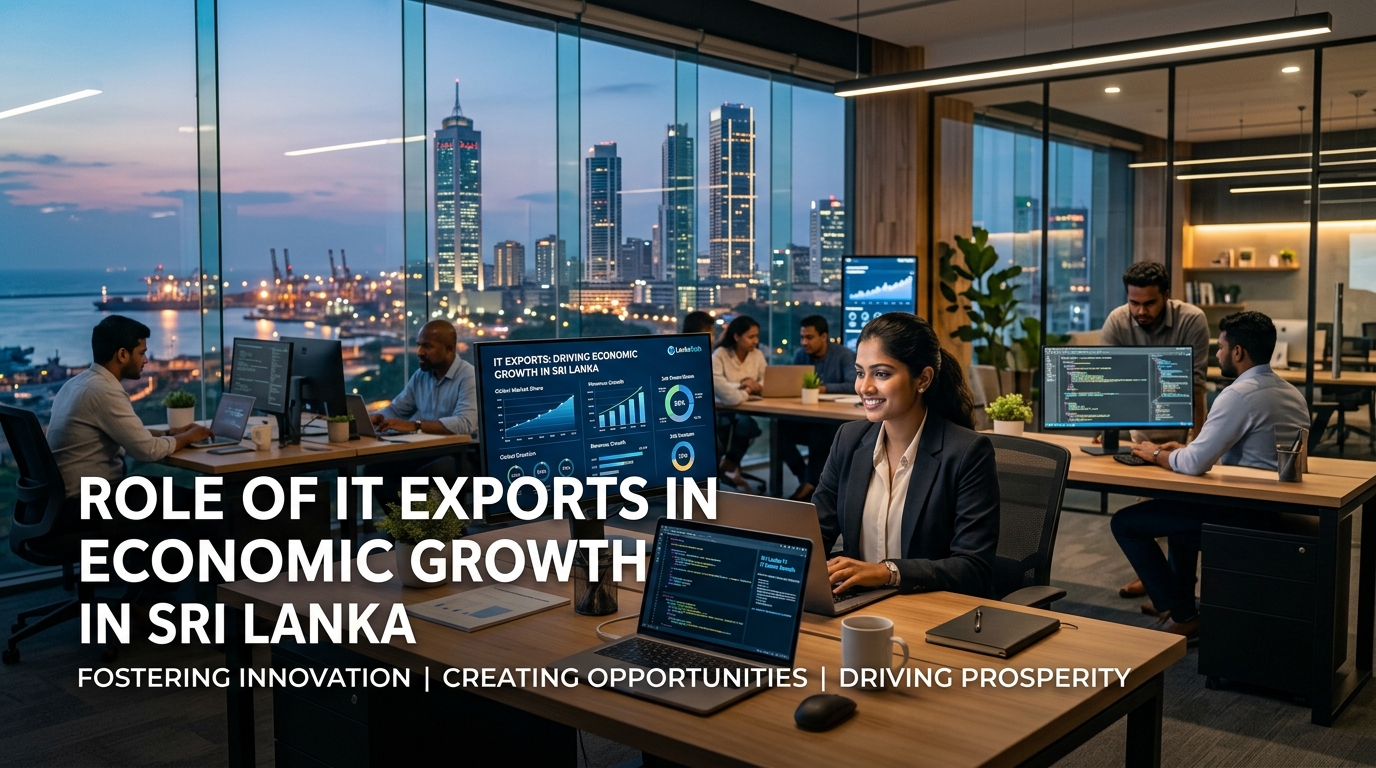
The Role of IT Exports in Sri Lanka's Economic Growth
Of all the sectors driving Sri Lanka's export economy right now, IT and business process outsourcing services stand out for growing faster than almost everything else the country sells abroad. It's a smaller number than tea or apparel in absolute terms, but its growth rate and its resilience through a genuinely difficult few years make it one of the more consequential parts of Sri Lanka's economic recovery story.
The Numbers Behind the Growth
IT-BPM exports reached <cite index="27-1">$885.42 million in the first half of 2026 alone, a 17.63% increase that outpaced the growth of Sri Lanka's overall services exports</cite>. On a monthly basis, June 2026 alone brought in <cite index="27-1">$150.49 million from IT-BPM receipts, the largest single category within services exports that month, growing more than seven percentage points faster than the broader services sector</cite>.
Zoom out further and the pattern holds. The sector has <cite index="28-1">grown at roughly 8–10% annually between 2015 and 2024, and now accounts for approximately 4% of Sri Lanka's GDP — making it the second-largest source of foreign exchange after remittances</cite>. Government targets are ambitious: officials are <cite index="27-1">aiming for 8–10% export growth this year</cite>, and industry bodies believe the sector could <cite index="29-1">realistically reach $3 billion in export revenue and contribute $15 billion to the digital economy by 2030</cite>.
Why This Sector Matters More Than the Raw Numbers Suggest
A few things make IT exports disproportionately important to Sri Lanka's economic picture, beyond the headline dollar figures.
It earns foreign currency the country badly needs. Since the 2022 debt default, foreign exchange availability has been one of Sri Lanka's central economic constraints. A sector that consistently brings in dollars — and does so at a growth rate outpacing most of the traditional export base — plays an outsized role in stabilizing the currency and funding imports the country still relies on.
It's proven unusually resilient. Despite a sovereign default, fuel shortages, and political upheaval in recent years, <cite index="28-1">the sector kept growing at 8–10% CAGR through that period</cite>, which says something meaningful about its underlying demand — much of it comes from long-term contracts with international clients who aren't especially sensitive to Sri Lanka's domestic political cycle.
The official numbers likely understate its true size. Industry leaders argue that <cite index="29-1">offshore invoicing, remittance-based inflows, and the rise of independent freelance tech work are masking the sector's actual economic contribution</cite>, since many firms began routing billing through offshore hubs like Singapore and Dubai during the 2022 crisis to manage currency risk — meaning the real economic footprint of Sri Lankan tech talent may be considerably larger than official export statistics capture.
What's Actually Being Exported
The growth isn't limited to one narrow service line. <cite index="28-1">IT-BPM as an export category spans software development, business process outsourcing, knowledge process outsourcing, and shared services, represented in large part by SLASSCOM's 420-plus member companies, which account for roughly 90% of the sector's export revenue</cite>. This diversity matters for resilience — a downturn in one sub-sector (say, basic BPO work facing automation pressure) doesn't sink the whole category if software development and higher-value KPO work continue growing.
It's also worth noting the sector isn't operating in isolation. In the same period IT-BPM was surging, <cite index="32-1">financial services exports climbed 29.56%, and electrical and electronic component exports jumped over 123%</cite> — suggesting Sri Lanka's broader knowledge-based and technical export categories are moving together, reinforcing each other's growth rather than competing for the same limited pool of skilled workers.
The Workforce Behind the Export Numbers
None of this growth happens without people. The BPO/IT-BPM workforce alone stood at <cite index="33-1">roughly 90,000 professionals as of 2024, with more than 7,000 new university graduates entering the sector annually</cite>, and Sri Lanka's competitive position rests heavily on <cite index="33-1">strong English proficiency — among the highest in South Asia — alongside university partnerships and technical certification programs</cite>.
This creates a fairly direct link between export growth and employment growth: as international clients award more contracts to Sri Lankan firms, the sector needs more engineers, analysts, and project managers to deliver on them, which is part of why IT consistently ranks among the country's fastest-hiring industries even during periods when other sectors are contracting.
Risks to the Growth Trajectory
The story isn't risk-free. Industry analysis points to <cite index="33-1">talent retention, economic volatility, data security, and the longer-term impact of automation as ongoing risks the sector has to manage</cite>, even as providers invest in compliance standards and training to offset them. Global competition is also real — Sri Lanka competes for the same outsourcing contracts as much larger labor markets like India and the Philippines, and while the country punches above its weight on English proficiency and niche capabilities in areas like finance and legal process outsourcing, it simply doesn't have the sheer workforce scale of its larger regional competitors.
There's also a structural fragility worth naming: much of the sector's growth depends on continued confidence from international clients who pulled back or paused contracts during the 2022 crisis. The National Export Development Plan's 2026–2030 targets treat continued recovery, rather than a full return to pre-crisis momentum, as the realistic baseline.
What This Means for Sri Lanka's Broader Economy
IT exports won't single-handedly resolve Sri Lanka's macroeconomic challenges — the sector, at roughly 4% of GDP, is still a fraction of the overall economy. But its role goes beyond its direct size: it's one of the few export categories growing meaningfully faster than the overall economy, it earns foreign currency the country needs for far more than just tech-sector purposes, and it has proven more resistant to the shocks of the past few years than most other industries.
For a country working to rebuild fiscal and currency stability after 2022, having one sector that keeps growing at close to double digits, employing tens of thousands of graduates and drawing in dollars from clients largely insulated from domestic turmoil, is a genuinely valuable piece of the recovery — even if it isn't, on its own, the whole answer.