
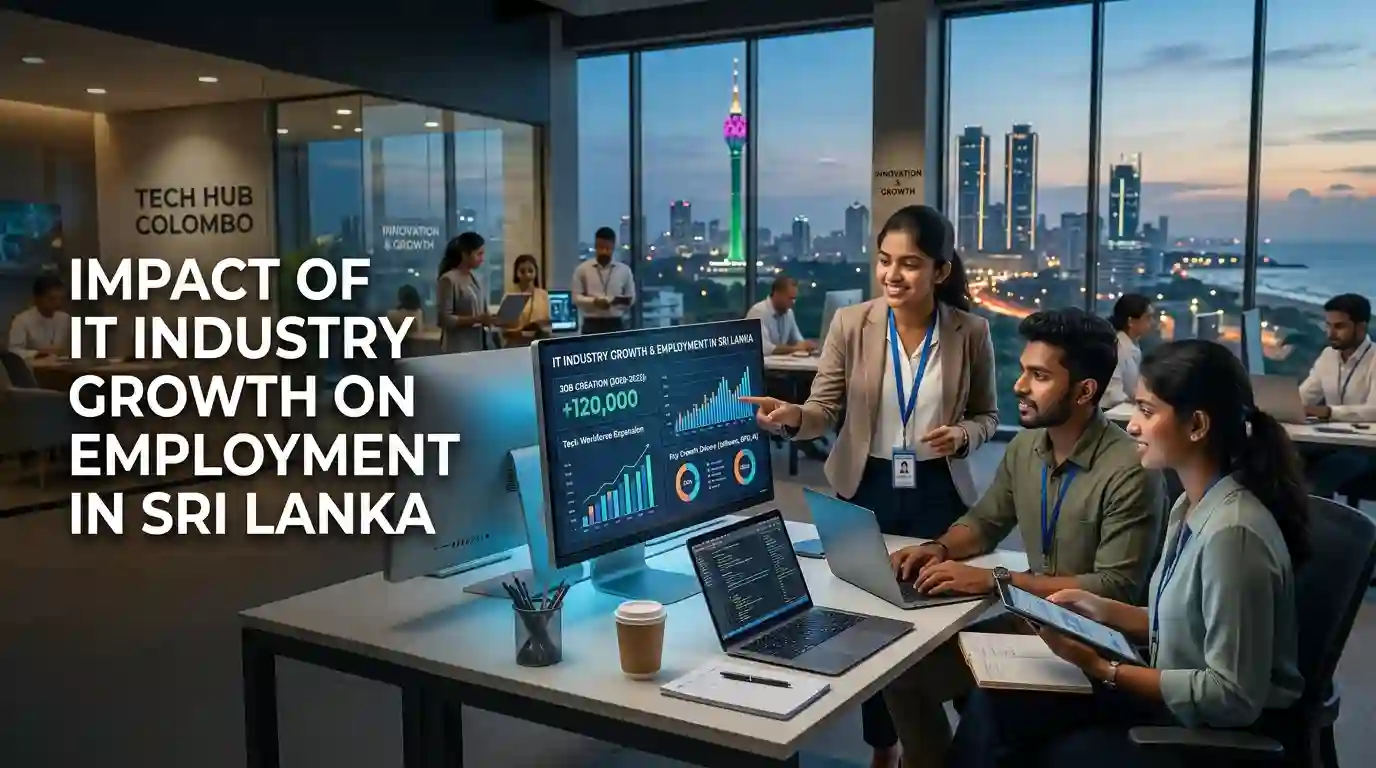
The Impact of IT Industry Growth on Employment in Sri Lanka
Sri Lanka's tech sector has quietly become one of the country's most important economic stories of the past few years. What started as a modest outsourcing and software services industry has grown into a genuine employment engine — and unlike some other sectors, its effects reach far beyond the people who actually write code for a living.
How Big Has the Growth Actually Been
The numbers tell a fairly dramatic story. Sri Lanka's tech industry has expanded from roughly $1.2 billion in 2020 to close to $2.8 billion by 2026 — well over doubling in six years, even through a period when the broader economy was dealing with a debt crisis, fuel shortages, and political instability. The sector now employs over 150,000 IT professionals directly, with tens of thousands of new positions expected to open in a single year as companies keep expanding.
What makes this more interesting than a typical growth story is where the money is coming from. IT and business process outsourcing services now sit alongside tea, apparel, and tourism as one of Sri Lanka's genuine foreign-currency earners, with export-focused software companies, international BPO operations, and remote-first employers all drawing revenue from outside the country and spending it, in large part, on local salaries.
Where the Jobs Are Actually Being Created
The growth isn't evenly spread across one type of role. A few areas stand out:
Software engineering and QA remain the largest hiring categories, driven mostly by export-focused firms serving clients abroad rather than the domestic market. Cloud computing, DevOps, and cybersecurity roles command the highest salaries, often reaching LKR 300,000–400,000+ a month for senior professionals, well above most other white-collar sectors in the country. AI and machine learning are the fastest-growing specializations, alongside fintech and e-learning, as global demand for AI talent spills over into markets like Sri Lanka that can offer strong technical education at a lower cost than Western hiring.
Entry-level roles typically start in the LKR 50,000–100,000 range, which — while modest by international standards — is often meaningfully higher than comparable starting salaries in other local industries, which is part of why so many graduates are steering toward tech degrees and bootcamps.
The Remote Work Effect
One of the more significant employment shifts has been the rise of remote and hybrid work paid in foreign currency. A large share of Sri Lankan tech workers now work fully or partially remotely, often for companies based in Europe or North America, taking advantage of reasonable timezone overlap and a strong pool of English-speaking technical graduates. This matters for employment in a way that goes beyond the individual worker: someone earning a USD salary while living in Kandy or Galle spends that income locally, supporting everything from housing to restaurants to transport in cities that otherwise see very little foreign investment.
Regional Spread, Not Just Colombo
While Colombo remains the center of the industry, smaller tech hubs are emerging in Jaffna, Kandy, and Matara, partly because companies are actively looking for cost savings — talent in these regions can come at a meaningful discount compared to Colombo salaries while still meeting the technical bar international clients expect. For employment purposes, this regional spread matters: it means IT-driven job creation isn't purely a Colombo phenomenon, and smaller cities are seeing a slice of the same growth, even if at a smaller scale.
The Ripple Effect Beyond Direct Tech Jobs
The employment impact of IT growth doesn't stop at software engineers and QA testers. A thriving tech sector pulls a surprising amount of secondary employment along with it — training academies and bootcamps expanding to meet demand for new graduates, real estate and rental markets around tech hubs adjusting to a higher-earning workforce, and a wider services economy (transport, food delivery, retail) benefiting from a growing base of well-paid, digitally-savvy consumers.
There's also a startup ecosystem effect worth noting: with venture capital flowing into Sri Lankan tech startups, a small but growing layer of entrepreneurial employment has emerged that didn't really exist a decade ago — people building their own companies rather than just working for established outsourcing firms.
The Other Side: Who Isn't Benefiting Yet
It's worth being honest about the limits of this growth. The IT sector's jobs skew heavily toward people with tertiary education and reasonably strong English proficiency, which means the employment benefits haven't reached the country's broader workforce evenly. Sri Lanka's overall unemployment rate has been gradually falling — hovering under 4% by 2025 — but that figure blends a booming tech sector with much slower-moving traditional industries like agriculture, which still accounts for a meaningful share of total employment despite far weaker wage growth.
There's also a competitiveness question. Sri Lanka's standing in global outsourcing rankings dropped sharply after the 2022 economic crisis, and while the 2026 outlook points to recovery rather than a full return to pre-crisis momentum, the sector is still working to rebuild the international confidence it lost during that period.
What This Means Going Forward
For job seekers, the practical takeaway is straightforward: technical skills — particularly cloud, AI/ML, and cybersecurity — currently offer some of the strongest employment and salary prospects available in the country, and that demand shows no clear sign of slowing. For policymakers and educators, the harder question is how to widen the pipeline so that this growth doesn't stay concentrated among graduates of a handful of well-resourced universities and training programs, and instead becomes a broader lever for the country's overall employment picture rather than a high-performing pocket within it.